Crabtree valley: is nothing sacred?
“I’m lost in time within the glacially carved Crabtree Valley, among primeval Douglas-firs, western hemlock, western redcedar, and Alaska yellow cedar. The oldest Douglas-firs in Oregon are rooted here. If immortality were possible, this might be the place. The trees drink from the sponginess of bog, springs, and two small lakes. The elders know the way of sun and shadow, snag and hollow, gnarl and crown.” — excerpt from my forthcoming book, Feathered Forest: Aloft with Birds in Ancient Trees.
This post appeared first on my Substack.
When I spent a long day in late September of 2024 wandering with old-growth expert John Cissell and Oregon Wild’s Chandra LeGue in one of the most resplendent ancient forests I’ve ever witnessed, I thought Crabtree Valley would be safe. How wrong I was. But as long as the trees still stand, as long as the roads, machinery, and chainsaws have not yet entered, we have a chance to protect what we love.
To give a sense of what it’s like to be within the Crabtree Valley, I’m sharing an excerpt from my new book—Feathered Forest: Aloft with Birds in Ancient Trees, forthcoming from Chelsea Green Press in September of 2026, and available for preorder.
For you to fall in love personally with this forest, you can follow the directions from Sweet Home in the western Cascades, featured in Chandra’s book: Oregon’s Ancient Forests: A Hiking Guide. (See this link for Crabtree Valley). I only ask that you go gently, and leave only a trace of wonder.
A growing national public outcry gives me hope we can stop theBureau of Land Management’s plan to clearcut the last old-growth refuges for endangered Spotted Owls, Marbled Murrelets and steelhead, Chinook and coho salmon; to pollute community drinking waters; and wreck treasured places, from the Crabtree Valley to Valley of the Giants, Alsea Falls, Mary’s Peak, and salmon-spawning streams entering the Rogue River.
March 23rd is the deadline for comments—time is short. Take action here.
As you read my excerpt describing my day with Chandra and John among the precious 1,100 acres remaining in a sea of logged-over lands, multiply this number to equal the 348,000 acres of old-growth forests remaining on BLM checkerboard lands mostly in western Oregon.
The Trump/Republican scheme would target both old-growth and mature forests — for a total of one million irreplaceable acres. All are on the chopping block in a drastic scheme to maximize logging across 2.5 million acres. These majestic older forests are the last of the last after decades of plundering public and private lands in western Oregon. They are critical refugia and corridors to the remaining ancient forests on national forests. Many are lower-elevation lands and close to where people live. Their value lie in keeping the forests standing—for biodiversity, carbon capture and storage, water quality, climate refugia, and for what can never be quantified—reverence.
The Crabtree Valley is designated a Research Natural Area and an Area of Critical Ecological Concern (ACEC). But there’s an ominous provision in this wrecking ball of a so-called plan to reconsider all special designations, which translates under this Trump Administration—scrap ACECs and Research Natural Areas. We will NOT let that happen. In fact, Oregon Wild is calling for people to nominate far more ACECs. The BLM invites people to do just that on a web page: Areas of Critical Ecological Concern.
Many groves have no names, no champions—and yet we must take our love for one place and extend it to all.
Here is the excerpt— an introduction to the Overstory section. This is the first sneak peek from Feathered Forest: Aloft with Birds in Ancient Trees.
CRABTREE VALLEY
OVERSTORY
I’m lost in time within the glacially carved Crabtree Valley, among primeval Douglas-firs, western hemlock, western redcedar, and Alaska yellow cedar. The oldest Douglas-firs in Oregon are rooted here. If immortality were possible, this might be the place. The trees drink from the sponginess of bog, springs, and two small lakes. The elders know the way of sun and shadow, snag and hollow, gnarl and crown.
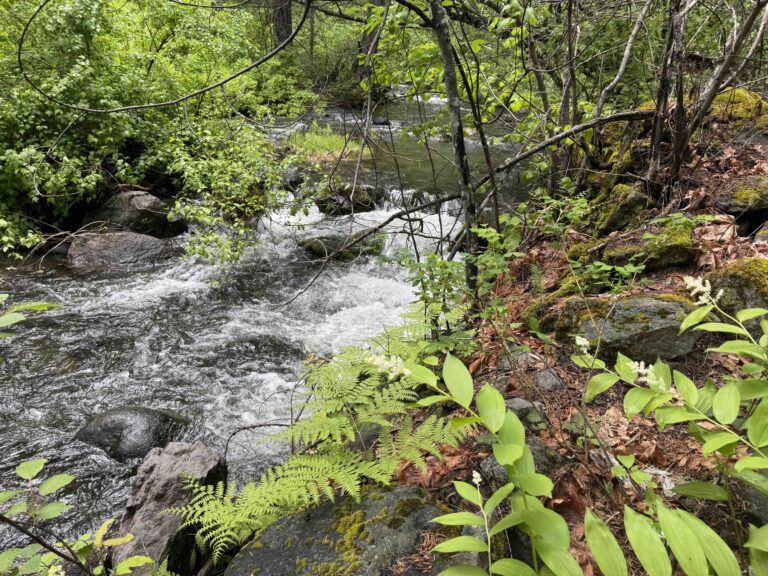
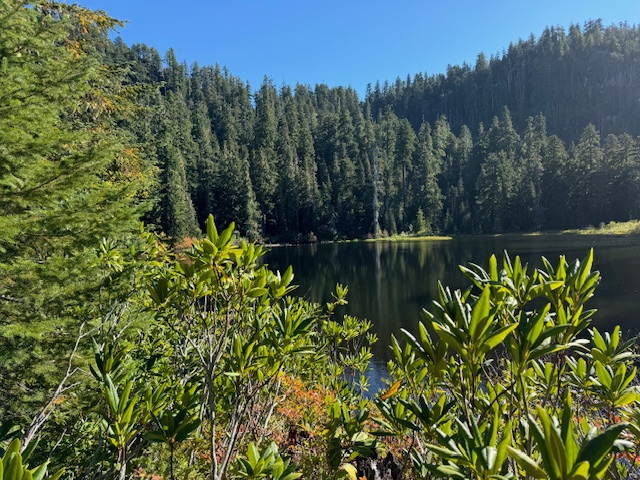
Wavering reflections of conifer spires in Crabtree Lake draw me closer. The lake is the oval eye with lashes of vine maples flashing leaves turned to flame and ember. Closing my eyes and listening to the jingle of Golden-crowned Kinglets, I’m once again lifted out of my human self. If I’ve ever wondered what climate refugia looked like, this is it. A circling Red-tailed Hawk halos the breathing trees. Hidden in the tree crowns, surely there are red tree voles lapping droplets from Douglas-fir needles.
Northern flying squirrels will paper the dusk in downward glides, evading Northern Spotted Owls. The imperiled owls have long known the Crabtree Valley. With few ancient forests left and Barred Owls advancing into their last strongholds to outcompete them, Spotted Owls are teetering toward extinction. I can only hope this sanctuary is inviolate.
If Shangri-La existed in Cascadia, this would be the mystical valley. But without environmental activism, the timber industry would have paid loggers to cut down every big tree, as they did for mile upon mile in the western Cascades, leaving a patchwork quilt of roads and clear-cuts. I give a silent prayer as if I could speak in the language of trees. “Please, stay this way for another millennium. Be the grove that seeds the surrounding places with all the biodiversity you are guarding.”
I wish the Crabtree Valley forest extended far more than two square miles, but I’m grateful for every square inch. Once owned by a timber company, its fate seemed sealed. In the 1970s, people who loved this place did not shrug and walk away from the impossible. They fought for it. Years later, the Bureau of Land Management bought the Crabtree Valley via a land swap, to become an Area of Critical Environmental Concern.
Turning to my companions John Cissel and Chandra LeGue, I feel privileged to be here with them. They are knowledge keepers, old-growth defenders, and educators who share the wisdom of ancient trees. Six feet, five inches tall, with a trim silver beard and wire-rim glasses, John is still dwarfed next to the trees escalating above us. He’s the co-author with his wife Diane of Best Old Growth Forest Hikes: Washington and Oregon Cascades. They’re updating the book by hiking many trails he’d not seen since the 1990s, when he covered 2,000 miles, now adjusting for wildfire and logging incursions. John’s a forest ecologist, past director of the Andrews Forest, and a bit like J. R. R. Tolkien’s character Treebeard, leader of the Ents, who said “Nobody cares for the trees like I do.”
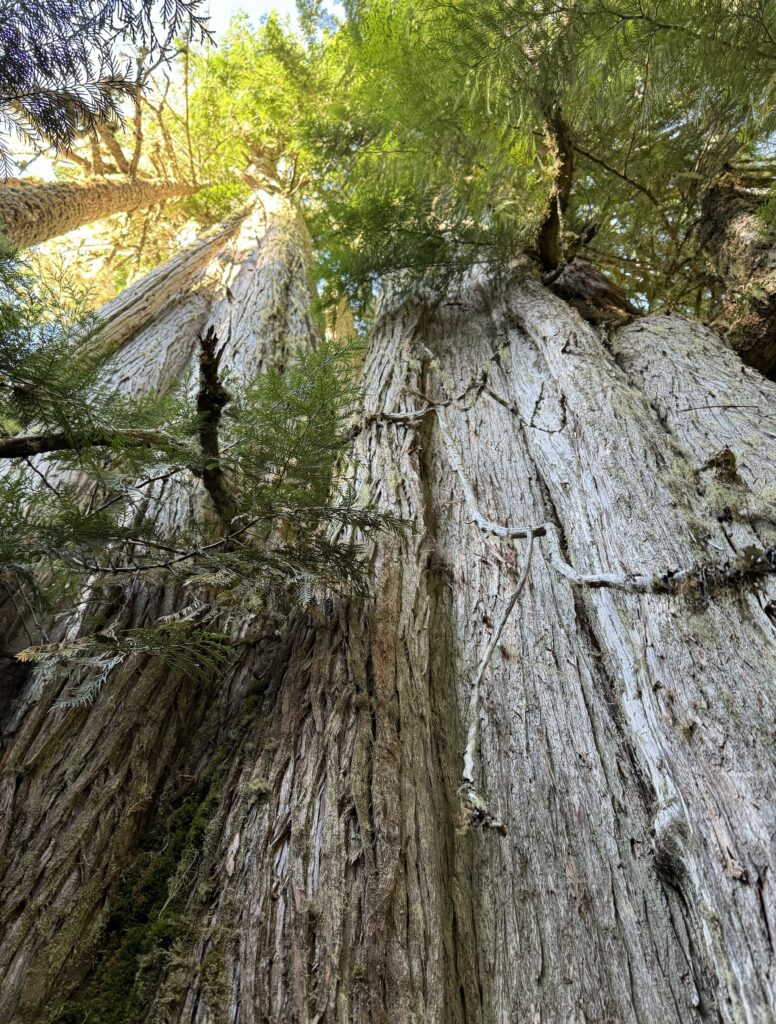
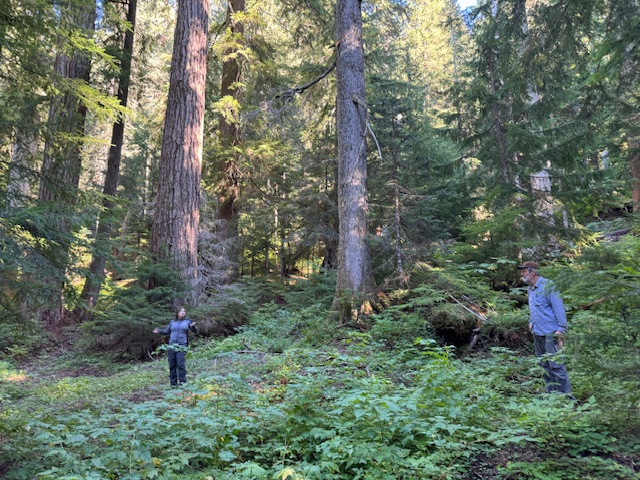
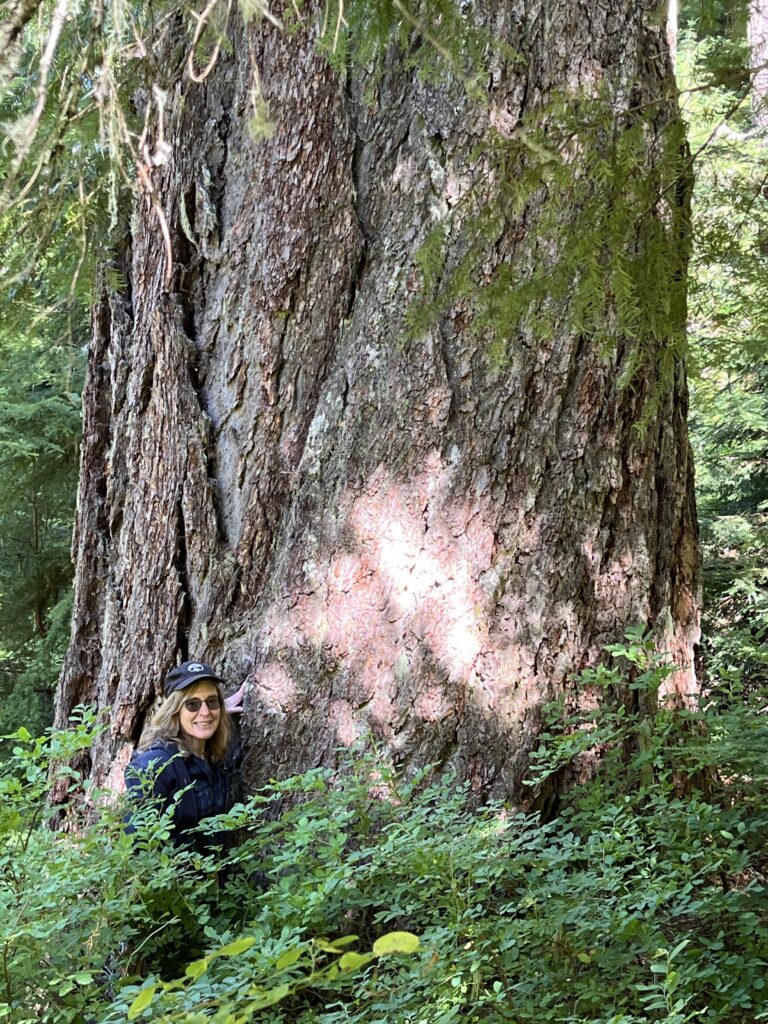
Chandra, of nonprofit Oregon Wild, is one of my favorite tree huggers. She’s leading us to the “King Tut” tree that could well be a thousand years old, measured at 270 feet tall with a diameter close to 8 feet, and 29 feet around. Named by activists to draw attention to Crabtree Valley’s significance, the tree is elusive. To get there, we depend on Chandra’s savvy ability to find her way off trail.
I’d become friends with Chandra through our mutual love of forest wilds and teaming up on a series I wrote for Oregon Wild’s fiftieth anniversary in 2024 called Every Wild Place Has a Story. In her forties, she’s a steady and seasoned eco-warrior for more than two decades of activism with Oregon Wild. As the author of the 2020 book Oregon’s Ancient Forests: A Hiking Guide, she’s come to know most of the state’s wildest groves. Like me, she’d rather not hustle along on a trail when there are plants to identify and curiosities of scat, tracks, and feather piles. We’d also backpacked in Badger Creek Wilderness in midsummer, when we were slowed by enticing ripe huckleberries and native blueberries.
This time, we find bear scat puckered with huckleberries, elk tracks in mud, porcupine-chewed chips below a small tree, and a mountain beaver burrow with a tidy pile of fresh clipped leaves and twigs at the softball-sized entry among ferns. This primitive forest rodent, related to squirrels (not beavers), lives a shy life in underground tunnels and, above ground, never strays for more than a few meters from any of the multiple entries.
Pressing through forgiving red elderberry, we avoid the chest-high, thorny Devil’s club. We come to several great redcedars forming an imposing wall as if one fused family. Loose, rich soils burst with brainlike coral mushrooms and angel wings, delicate white mushrooms shaped as the name suggests. Encircled by a half dozen hemlocks, redcedars, and Douglas-firs, each wider than the six- to seven-foot wingspan of a bald eagle, the three of us fall into revery. A bit later, I ask John how he feels here.
“We all come from somebody and somewhere, but we all come from Mother Earth,” he tells me. “We only have one, and we need to take care of her. For me, old growth is where I feel that connection come alive.”
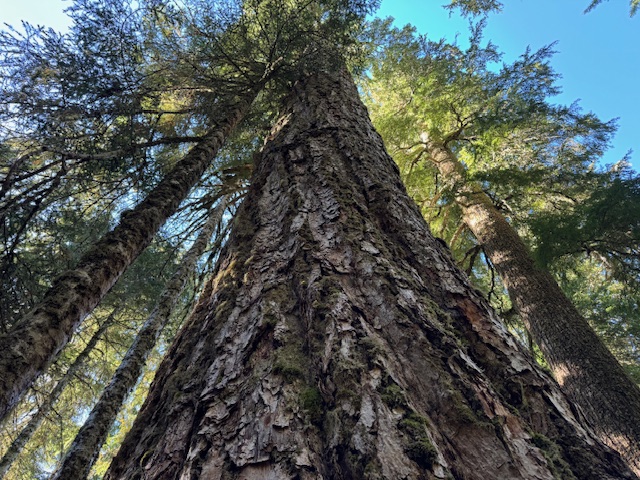
I’m nodding. We’re elfin and childlike in comparison. Scrambling over barrels of mossy nurse logs, Chandra, John, and I come to King Tut. A ridge of bark like fusilli pasta wraps from the base and coils upward as far up as we can see. While spiraling wood grain helps trees withstand stress and distribute nutrients, why would the pattern appear in the craggy bark? John suggests an old fire scar might have been the source. For me, this tree is not King Tut from far away Egypt, but Spiral Tree.
Spiral is the way of birds wending around the trunk like the shaft of a feather. Spiral are pinecones, snail shells, and galaxies. At night, lying on my back to look at constellations, I’m spiraling into the fourth dimension of time with starlight emitted two billion years ago,
Gazing up the cliff of the thousand-year-old tree, I see my life as one blink of the eye of Crabtree Lake. I’m a tiny mite clinging to the barb of an owl feather. No matter. With every second remaining, I seek the winding way—flying with birds into the overstory.
#
Thank you for reading.