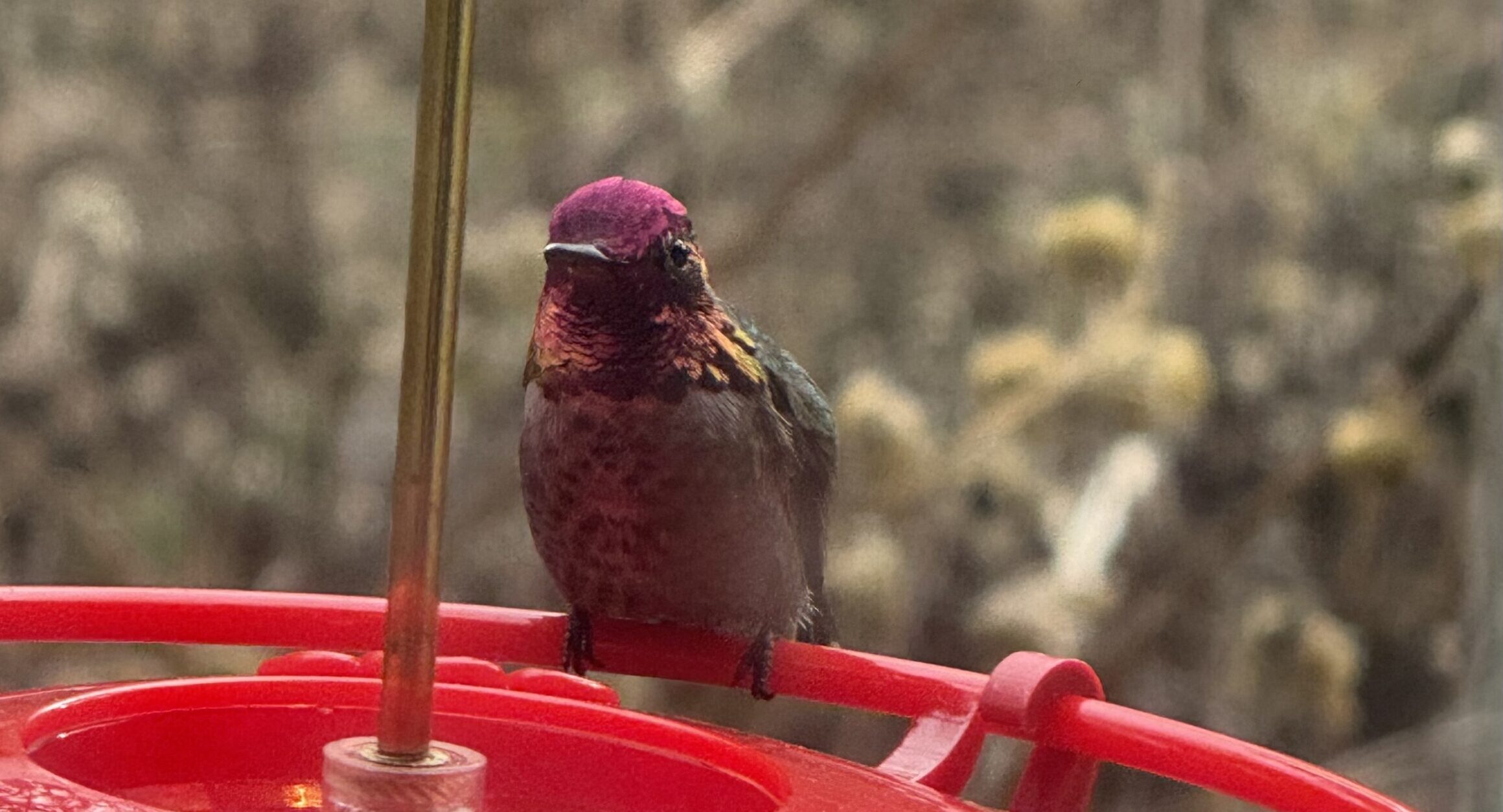
My Winter Hummingbird Obsession
In a Quest to Keep One Wild Bird Alive, I find Unexpected Resilience
(This piece appeared first on my Substack- marinarichie.substack.com)
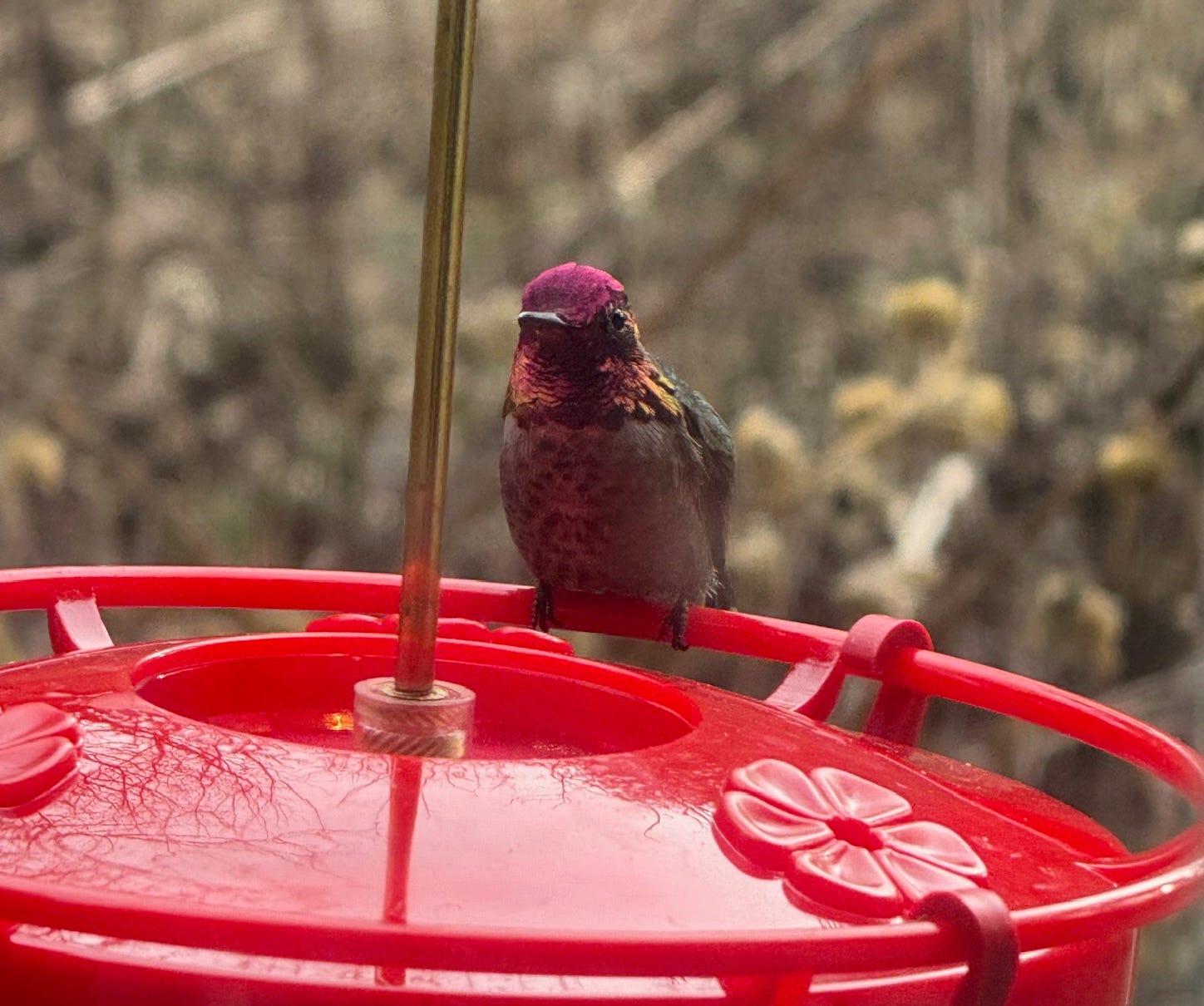
Each morning I rise in the dark. Check the temperature outside. Assure the two hummingbird feeders glow from the bulbs heating the sugar water. At dawn, I walk outside and listen for the click click click calls of the flashy male Anna’s Hummingbird. Typically, I hear—nothing. I fret, especially if the temperature has dipped into the teens here in the pine woods a few miles south of Bend, Oregon.
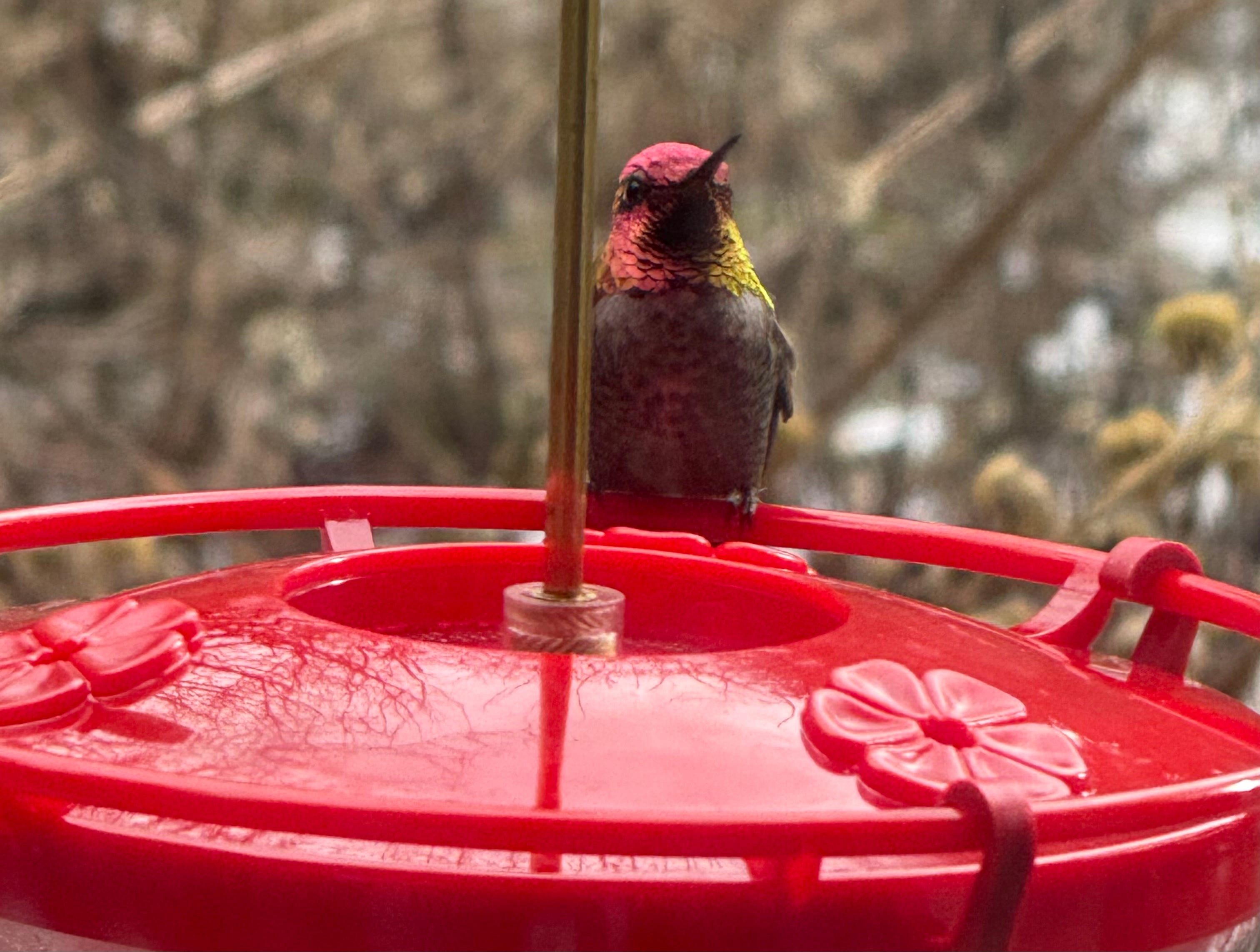
When he does show up in a fury of wings whirring at a rate of more than a thousand wingbeats per minute, I feel my heart race from a resting pulse of 50 beats per minute. to perhaps 80. In contrast, this miniscule bird weighing about two pennies must fuel a body with a heart rate often at 1,200 beats per minute.
In a wash of relief, I watch him hover, then perch on a red plastic feeder with fake flowers, and dip his needle bill into the holes to sip the sugar water version of nectar I have kept warm and fresh.
In the right light, when he lands on a feeder close to the window of my home office desk, his head and throat feathers flash an iridescent magenta and lime as prism microstructures fracture light into a spectrum of colors. The Anna’s Hummingbird is a tropical flower gone astray—the migratory bird who stayed.
In the turmoil of terrible news—ICE raids on people of color who immigrated to America for a better life, masked armed agents throwing protesters to the ground, and the ICE murders of Renee Good and then Alex Pretti in Minneapolis—I am obsessed with one wild bird. As I try to do my part as a protesting, outraged, and horrified American, the attention I give to the Anna’s Hummingbird helps fuel me to continue. He’s becoming my teacher of resilience. The least I can do is return the gift with my daily offerings.
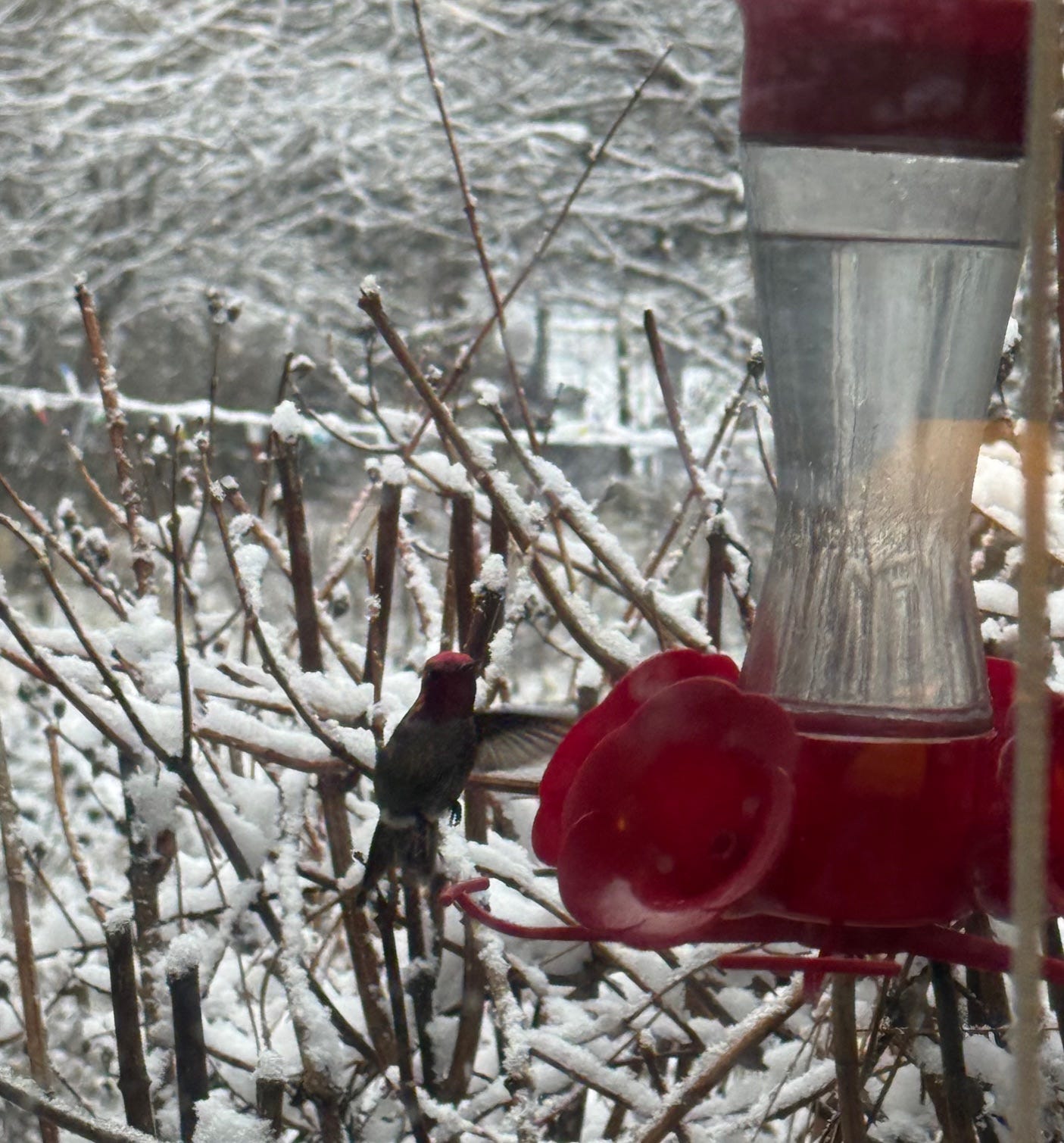
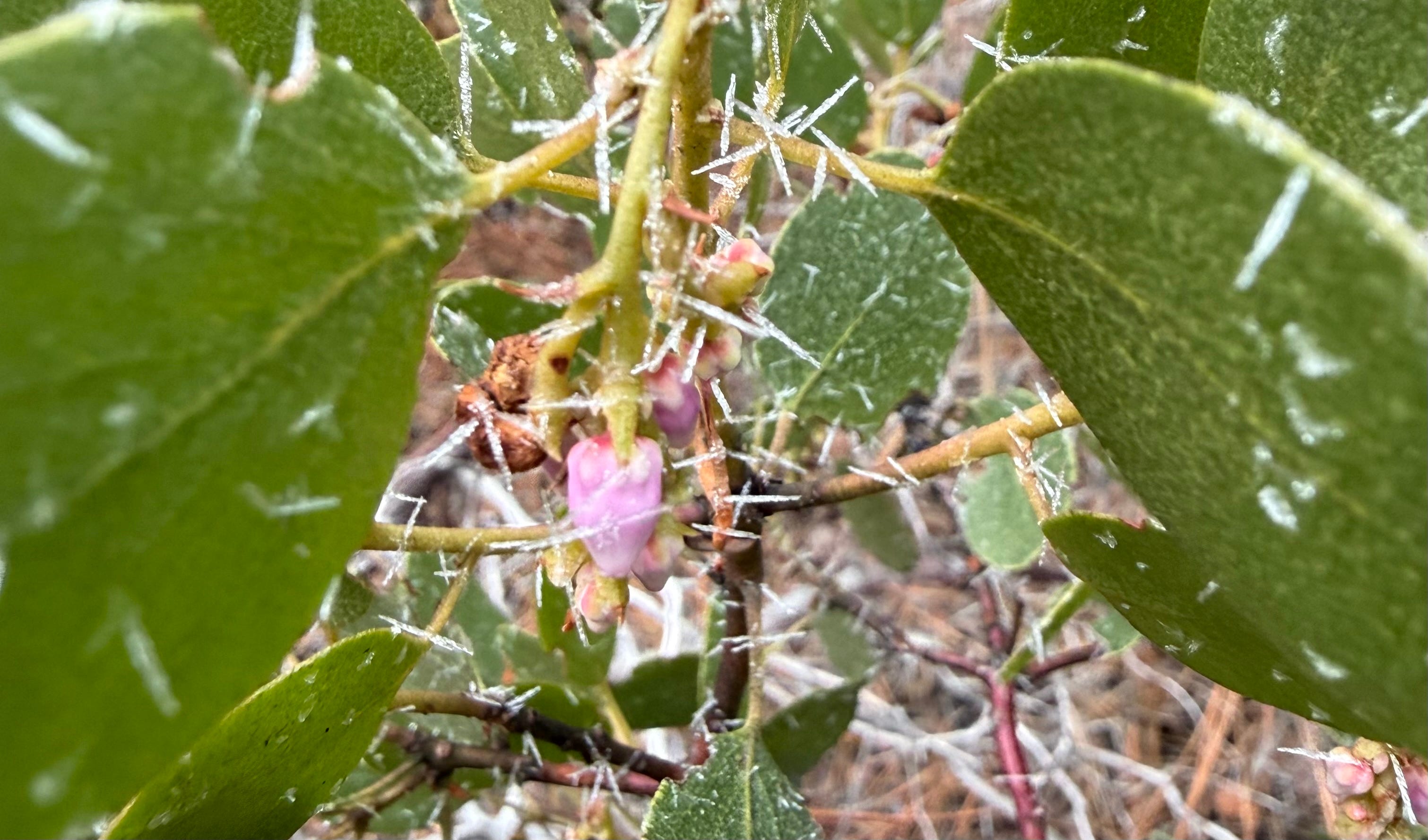
To migrate or not to migrate? Which is more dangerous? The Anna’s Hummingbird —by staying is avoiding the multitude of perils and finding more than feeders—winter insects (equipped with nature’s form of antifreeze), sweet sap flowing from trees on warmer days, and sometimes even a blooming flower taking a risk in a bout of warmer weather. But if temperatures plummet to zero, it’s a severe test for survival.
Anna’s Hummingbirds are among certain kinds of birds that have increased their range northward in response to humans. For the first half of the twentieth century, they nested only as far north as Southern California’s chaparral of northern Baja and the Upper Sonoran life zone. In Oregon, they began showing up in the early 1960s and gradually expanded up the Pacific Coast into southern British Columbia.
The wee birds are taking advantage of planted flowers in gardens and hummingbird feeders. We do have our good sides—especially when offering native plant yards that yield far more insects than non-native. Flowers and feeders are not enough on their own. All songbirds feed their young high-protein insects. As my friend, native plant advocate, and copyeditor Susan Campbell reminds me— we ought to stop saying pollinator-friendly yards and replace that term with insect-friendly—giving due respect to the entire suite. Biodiversity—yes!
Before winter sets in, most Anna’s Hummingbirds in Central Oregon do migrate to more welcoming climes. However, our Christmas Bird Count revealed twelve —all seen at feeders. For multiple days before the count date, the Anna’s Hummingbird showed up here, but not on the day of the count. Almost a week passed. I worried. And then he returned—or was it another male?
In contrast, the family of Rufous Hummingbirds in our wild yard departed in early fall to fly some 2,000 miles south to western Mexico. Like all neotropical migratory songbirds wintering south of the border, they flew across with ease. There, the fiery hummingbirds find flowers, nectar, insects, and balmy temperatures for months until it’s time to fatten up and trek north again.
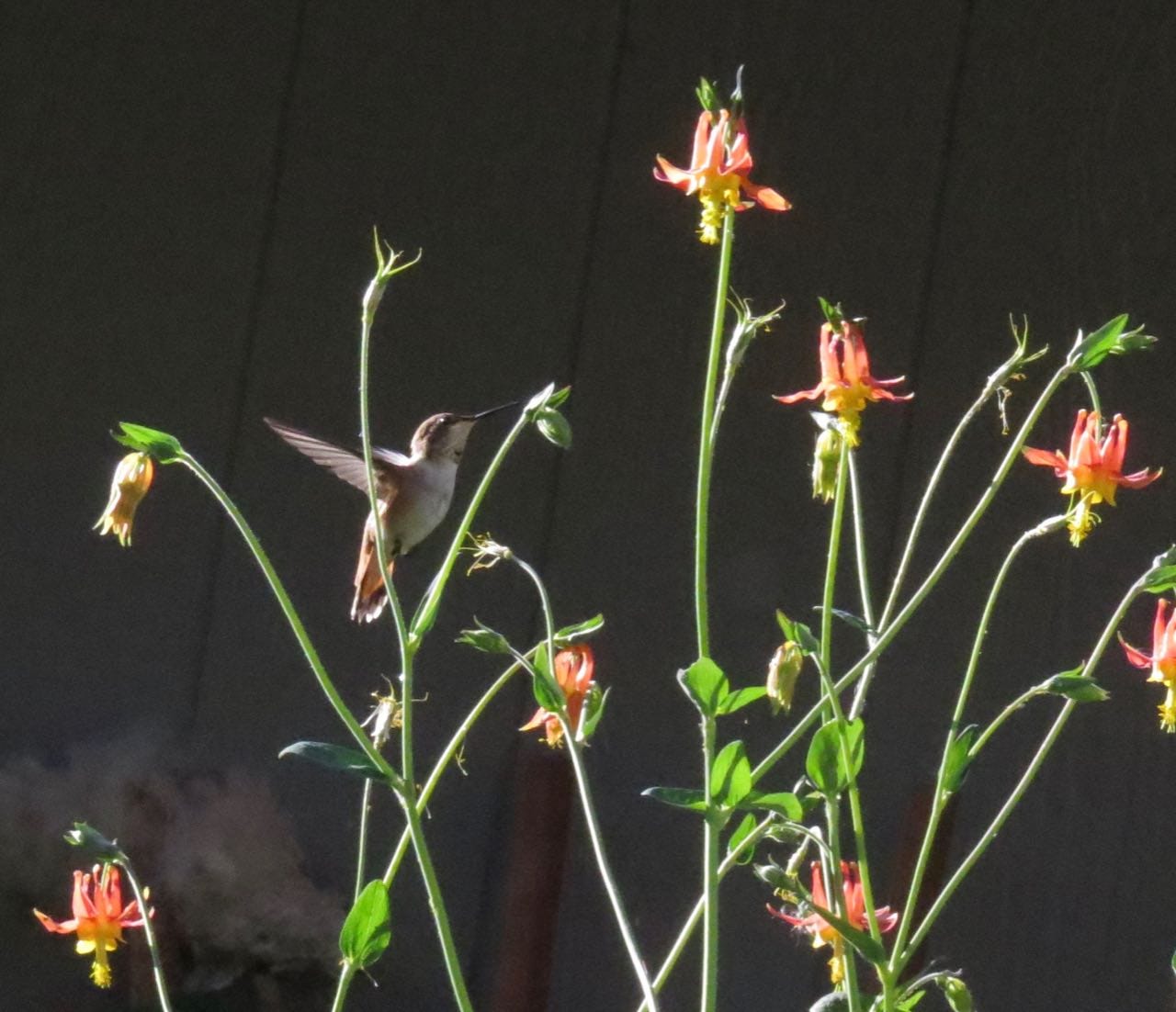
There are no border walls high enough to stop a high-flying bird. But their journeys are ever more perilous. Climate chaos causes extreme weather—fearsome winds, atmospheric rivers, drought, and abrupt temperature swings. Add buildings with lights that attract night-migrating birds to their deaths. Add the incessant development of natural habitats. Add outdoor cats killing 2.5 billion songbirds every year in North America. Add this administration’s determination to wreck our public lands, waters, and the air we breathe. It’s miraculous that birds are still making the journey, but their numbers are far fewer. I feel the loss deeply.
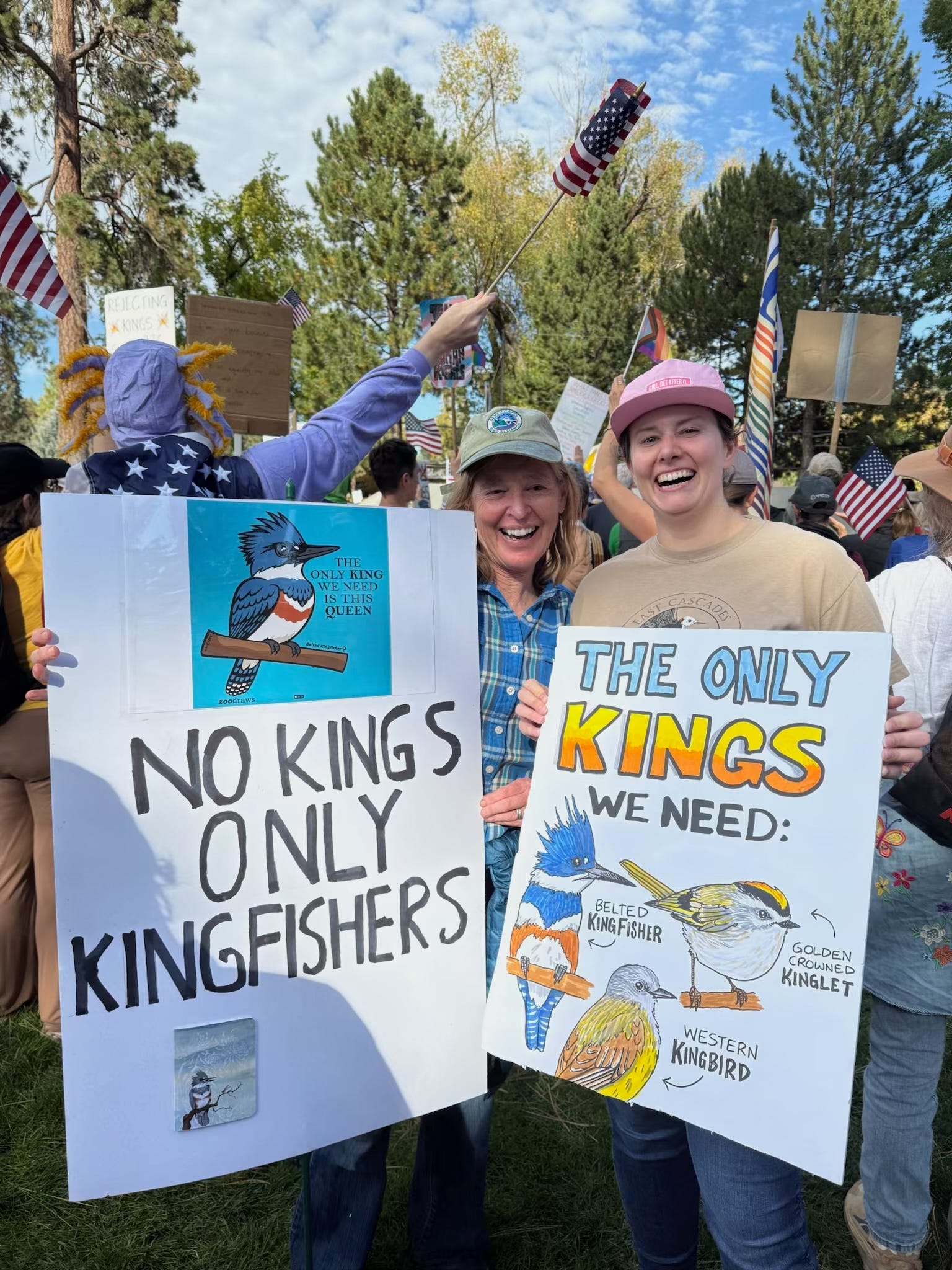
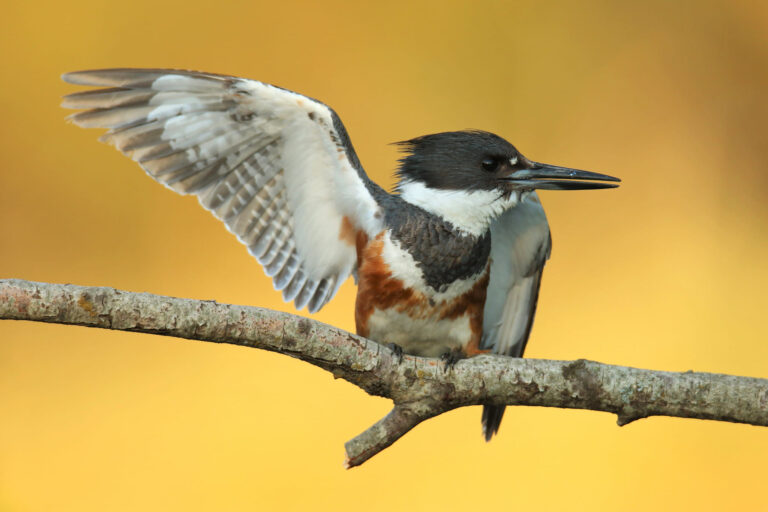
Isn’t it time to realize we are all in this together? Without caring for the planet that sustains us, we will have no future. When we attend to the natural world, we immerse where we belong. In this state of belonging, we find our kin—all who are stepping up. I believe, too, that we must protest it all —the outrage against fellow humans and the more-than-human world. (See photo below from a No Kings Day protest in Bend where I met a fellow lover of kingfishers).
But it’s tough. Really tough right now. The speed of decimation of all I hold dear is nauseating. We need to find lessons in resilience—and the Anna’s Hummingbird offers several.
Like many of his kind, he saves energy by entering a state of torpor. His heartbeats may drop to some 50 beats per second. Reading more about torpor in my gigantic book, The Audubon Society Encyclopedia of North American Birds, by John Terres, I learned several astonishing facts about hummingbirds, including Anna’s. Terres described the “deathlike torpor—their body temperature is lowered, breathing reduced, and metabolic rate lowered.” They can enter torpor quickly and then revert to their normal high speed.
Torpor is not reserved for cold nights. Anytime energy reserves are low, hummingbirds can enter this temporary state. To avoid the emergency measure that makes a bird appear almost lifeless, a hummingbird will store insects and/or sugar water in a crop rising from “an outpocketing of the wall of the esophagus,” Terres wrote. Grosbeaks and finches will store seeds in their crops at night in a similar way to avoid a long period without food. They know the art of saving and snacking, another lesson to note.
From torpor, I find an antidote to despair and apathy. Rest up. Lower heart rates. Come back rejuvenated. The harder it gets, the more rest and slowing down we need to return into the fray. But know, too, that it’s dangerous to stay in torpor too long. In our case, we can’t let those who are undoing Democracy and environmental protection race ahead too far.
Even when feeling as alone as the Anna’s Hummingbird of our yard, know that we are in a flock looking out for each other. Songbirds of different species often forage together, depending on one another to signal danger approaching.
Finally, Attend to natural beauty. Before dawn, I’m outside to breathe in the coming day, check water baths for birds, and watch silhouettes of pine trees and thickets offering cover for wildlife. I practice gratitude—and turn to writing in my journal with a cup of coffee (after I’ve fed our dog and built a fire in the woodstove).
Right now, I’m solo here with our Labrador Pepper while my husband is on an international adventure. I’m finding a rhythm and solidarity with the solo Anna’s Hummingbird. At some point in the day, I will do my share of actions—engage, engage, engage—then a bit of torpor, snacking, and walking in the forest—as I will do now.
February is around the corner. Let there be snow in the West and warming respite in the East. Let there be the radiance of shining, iridescent hummingbird feathers on the darkest of days.
Love those Kings we need posters !! Love the ongoing series of judicial setback for Trump and his retribution attempts. And now His hand crafted Supreme Court telling him most of his Tariffs violated the constitution. And even Congress is showing a bit of glimmer of taking back som of their constitutional duties and powers that they have let Trump have or control. Our prayers continue daily.
I forgot to mention Anna’s continue with their significant year round resident numbers increase here in the Boise area. It is hard to go to many of my favorite birding spots and not see them year round now.