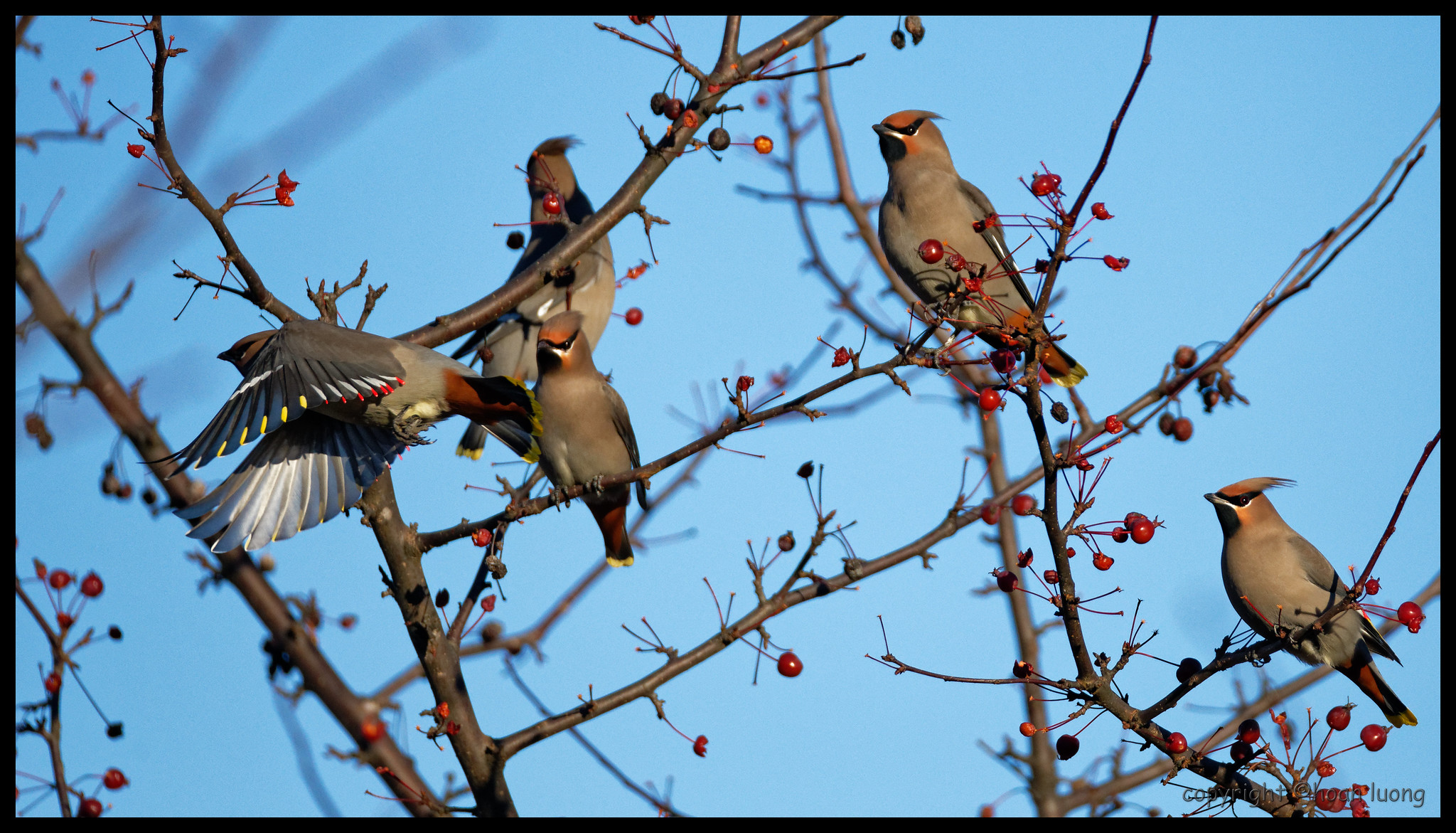
Waxwing Choreography
Murmuration: a great cloud of birds that fly in orchestrated formations
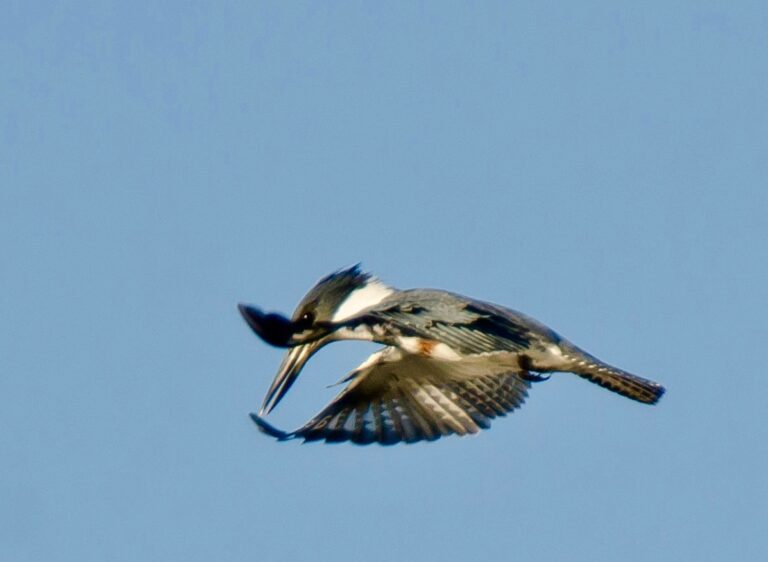
As a lover of the Belted Kingfisher, I admit to a little straying to another bird as gregarious as the kingfisher is solitary. I’m having a flirtation with the murmurations of Bohemian Waxwings over Missoula, Montana.
There, on the University of Montana campus, I saw them –not a handful, not a hundred, but more than a thousand waxwings in a torrent of aerial synchronicity. The flock converged to form a cornucopia of winged beating hearts, then scattered like wind-driven ashes, only to mingle again. I watched with yearning as they whisked away over library and clocktower, over students inside classrooms, over bare-limbed maples and cottonwoods, and vanished into the frosty February air.
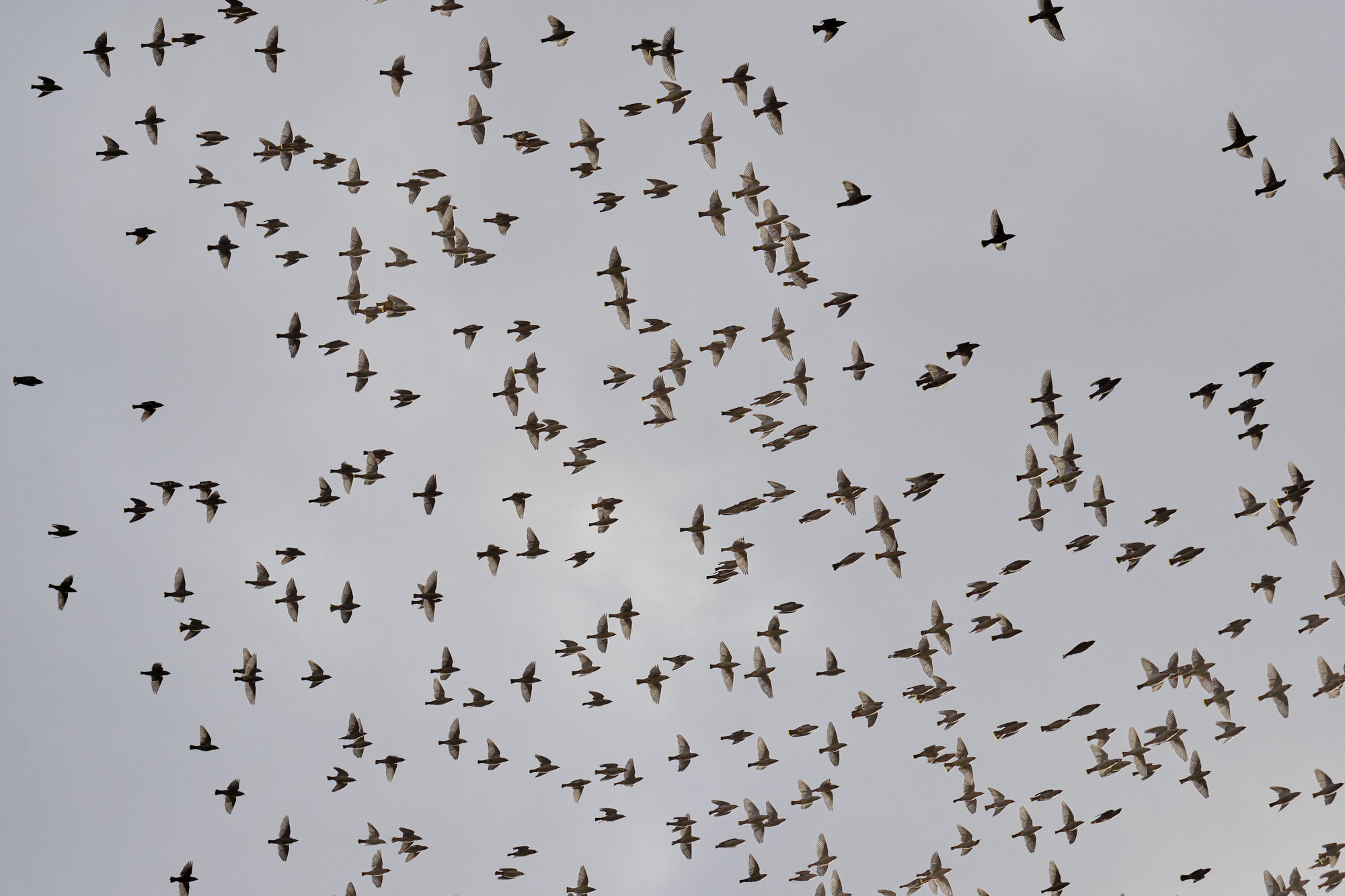
How is it possible for the birds not to bump a wing and fall from the sky? What might we learn from their way of living in such close companionship? Delving into what scientists have discerned about murmurations of birds–starlings, waxwings, and sandpipers–I am struck by one necessity.
There is no leader–no pastor, mayor, governor, or president. Instead, each individual maneuvers in ways that keep this close community in a communion. The brilliant choreography arises from every bird in a state of hyper-awareness.
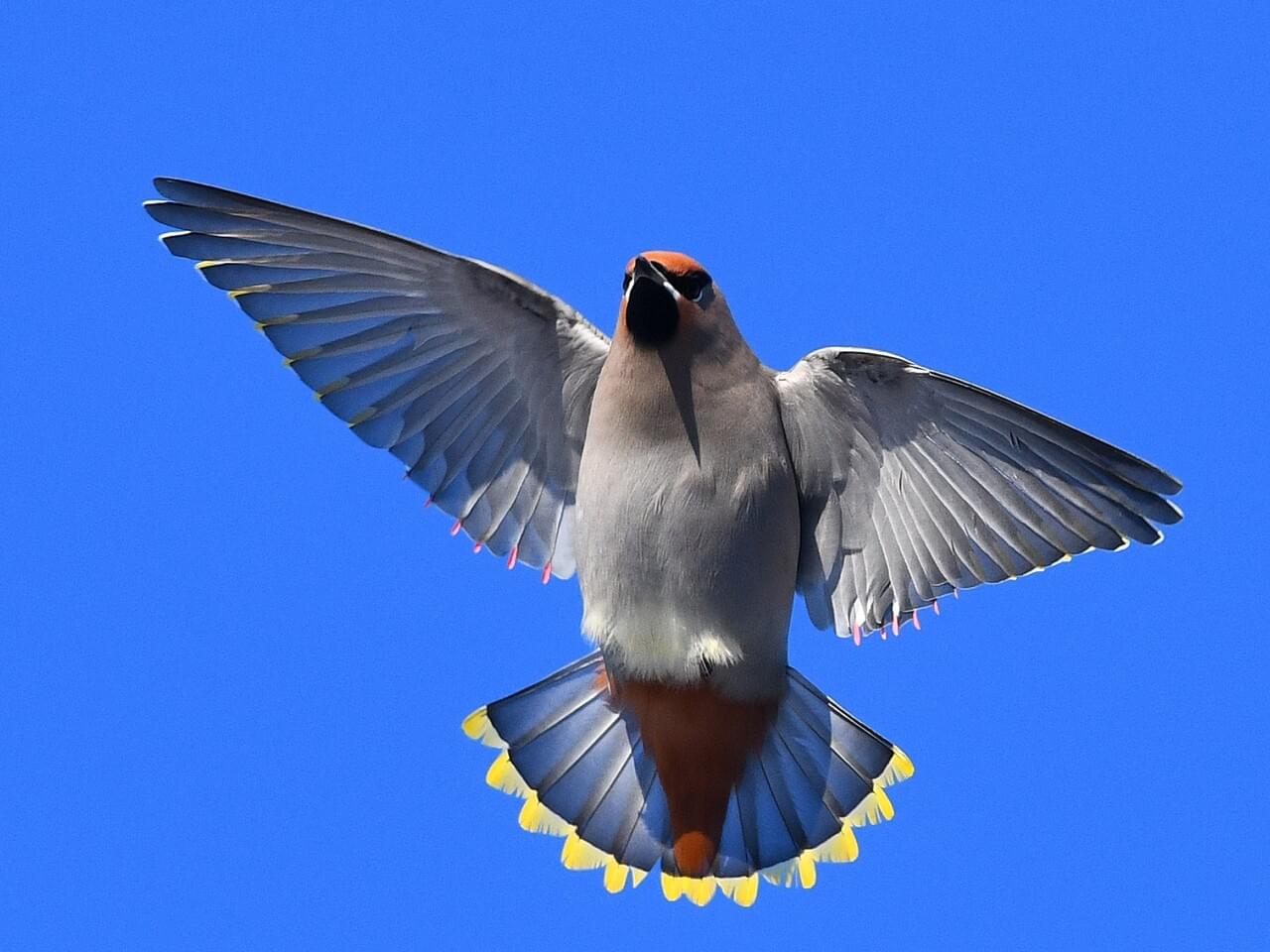
If I were one waxwing among the multitudes, I’d keep just enough distance to avoid a collision, while my quickening wingbeats coalesce with the flock’s forward momentum. But that’s not all. To fly in a flock is to be aware of the direction and speed of the entire group or I’d splinter away from the whole. My vision would have to be exceptional. Unlike the kingfisher, a predatory bird with forward-facing eyes, a waxwing has eyes on the side of his or her head–the better for spotting a peregrine falcon and keeping track of fellow flyers.
I know there are practical reasons for this aerial entanglement of Bohemian Waxwings– this dynamic knotting and unknotting into hypnotic patterns in the sky. There’s safety in numbers from predators and especially on migrations from Canada’s boreal forests south to the northern tier states. By sticking close together, they also can hone in on trees bearing the most fruits. Sharing information is efficient and energy-saving.
Yet, I also believe the waxwings teach us a way of living with one another–of holding up every person in a neighborhood without judgment, ranking, or partisanship. If we lived this way, we would honor individuality and creative expression within a heightened sensitivity of our common humanity and our common fate.
I am a bit wistful writing these words, yet I take heart from the spontaneous flocking of youth climate activists who are brave and shaping a new paradigm with roots in the tenets of indigenous peoples–of a gift economy with reciprocity. I feel their energy like the restless beauty of waxwing flocks and I want to find my place in the freshening gusts of their voices.
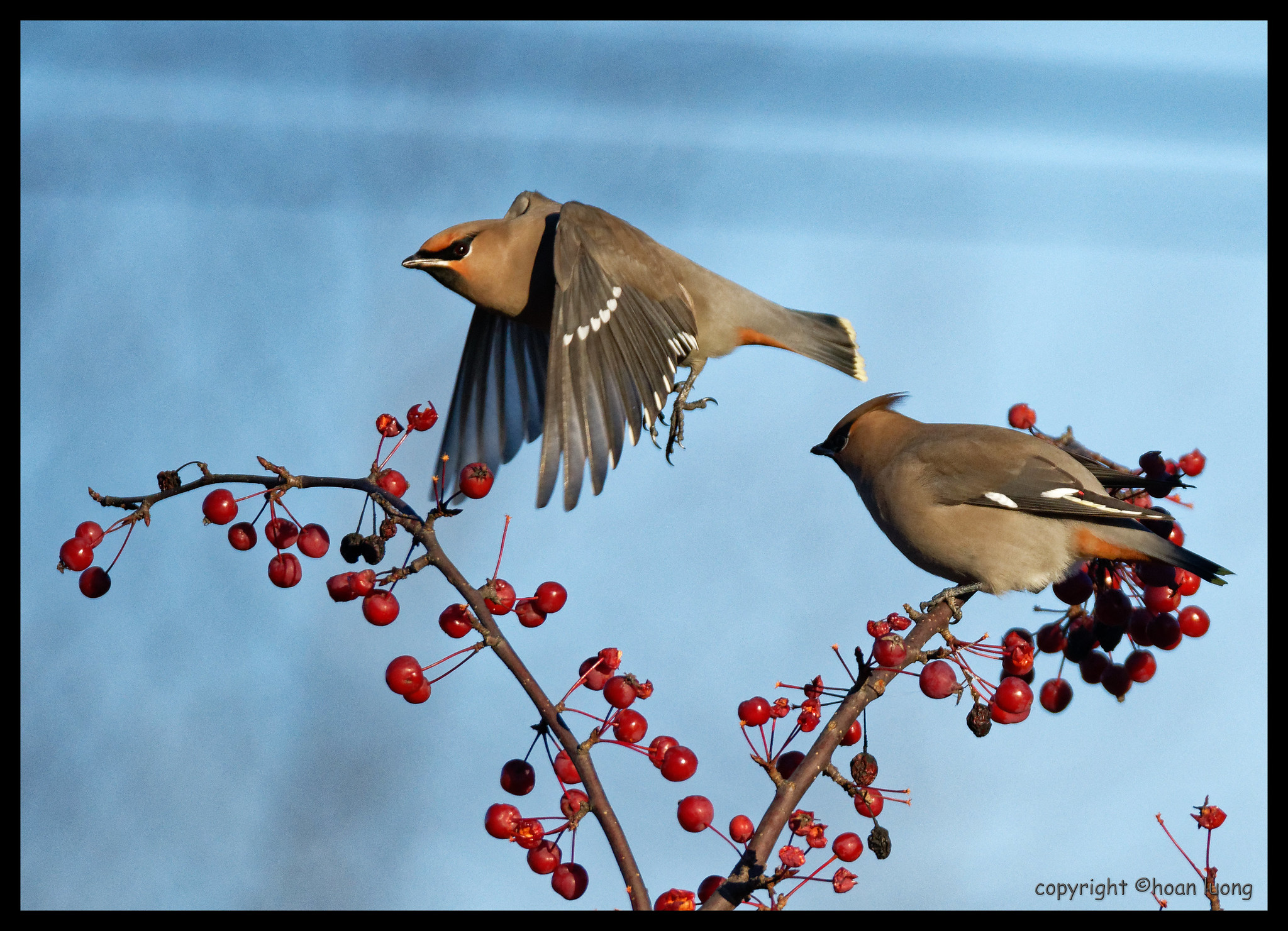
A couple days after reveling in the waxwing choreography on campus, I witnessed a more intimate scene among skeletal cottonwoods and the loden greens of ponderosas by Rattlesnake Creek. Bohemian Waxwings poured from the highest limbs of a tree like a slow-motion waterfall. Then, they ascended vertically in a crescendo of high-pitched keening notes–only to filter down upon the same perches. In the light cast through catbird-gray clouds, I could not see the brilliance of each bird, except for flashes of daffodil yellow in their tail tips–so like the Cedar Waxwing, except for the cinnamon undertail coverts.
Returning home to Bend from my brief foray to Missoula, I feel a little like a migratory bird, knowing I will always hold two places close to my heart–Oregon and Montana. This time, I carry with me a sense of lightness, as if I could be buoyed up in the air by a thousand wings, even as I flap mine to hold up others. In my journal the morning after seeing the birds on campus I wrote this poem:
Outside the Classroom…
Pluming across campus
Bohemian waxwings
a thousand strong
winnow the winds
in a precision
unrivaled by all who
study physics while
tucked into cubicles
Like a streaming comet
An unerring tornado
The rambling birds
emerge and merge
No wings touching
Every bird elevated
A kinetic synergy of
avian classmates aloft
#


I love your beautifully written, insightful posts! As a birder for decades I have known that the group name for a flock of European Starlings is a murmuration. I had no clue if something similar existed for waxwings so I looked it up and there is! A large flock is known as an “ear-full” or a “museum.” Who knew?! An ear-full I can see, but a museum?? Those Brits (I am assuming) came up with such unique, surprising, and oftentimes very fitting, flock “names.” My favorite though is an “exaltation of Larks.” Pretty perfect for those lovely vocalists. My second favorite (for one of my favorite birds) is “an unkindness of ravens.” Just wanted to share. I look forward to your next post!
Sue
Sent from my iPad
>
I love to look up the names of flocks as well–and thought that a museum was a bit odd–a living one for sure! This morning I was playing around with names for flocks of waxwings and came up with this one: A Philanthropy of Waxwings.. .although something more apt for their flight patterns might be A Whirlwind of Waxwings!
Good morning Marina, I was greeted by this stunning piece this morning. Thank you, it is so lovely. Robin
Sent from my iPad
>
Thank you Robin! Maybe a painting for you in the future?
Great, Marina. Thanks for this pre-Valentine greeting! Do the Cedar Waxwings also create murmurations?
Friend, Mike
Virus-free. http://www.avast.com
On Sun, Feb 13, 2022 at 5:00 AM Kingfisher Journey- Marina Richie wrote:
> Marina Richie posted: ” Murmuration: a great cloud of birds that fly in > orchestrated formations As a lover of the Belted Kingfisher, I admit to a > little straying to another bird as gregarious as the kingfisher is > solitary. I’m having a flirtation with the murmurations of Boh” >
Cedar Waxwings do too ! But I haven’t seen them in as BIG a flock as the Bohemians…
Marina, what beautiful photographs of a beautiful bird. Thank you so much for sending them. It reminded me of how much I enjoyed your visit to stillwater cove. Thank you Marina, Jerry
Thank you Jerry–I loved walking the land with you above the ocean, listening to birds, and then sharing fruit and conversation–and pouring over my Coastal Biology class journal–one of my most treasured belongings–and all because of you as my inspirational professor at OIMB! I may have to write a blog about that….
Marina ~ Another great post that gives us insight into both the birds and ourselves as humans.
I especially love this: “Yet, I also believe the waxwings teach us a way of living with one another–of holding up every person in a neighborhood without judgment, ranking, or partisanship. If we lived this way, we would honor individuality and creative expression within a heightened sensitivity of our common humanity and our common fate.”
And your poem provides a fine image. Thank you so much. xoA <3
Thank you Annis! And I miss you my poet friend–let’s connect soon.XOXO
I had been thinking the same thing last week! Then your dandy post showed up this morning. Let’s figure out our calendars. xoA <3
Mmmm. Your words add deep flavor to that piquant memory of you and I watching that whirlwind of waxwings stir the sky by Mount Sentinal. Thank you Marina. Yes to that pang of wistfulness in the possibility that tuning into waxwings might kindle “heightened sensitivity of our common humanity and our common fate.” The day after you left Missoula, a flock of waxwings dropped out of their wheeling cloud into a berry-bright mountain ash by Rattlesnake Creek–more birds than the slender tree could hold. The tree shook as the birds dropped in and rose back up to a nearby cottonwood, then back again, each time leaving the ash more lightly beaded with berries–a disrobing that must have pleased the ash, knowing her seeds would be scattered far and wide. Thank you for all the ways you attune my eyes and ears and heart to beauty.
And thank you for your poetry of waxwings–and from the perspective of the ash tree too. Yes–so glad we witnessed the waxwings together in Missoula…amplifying the experience in shared wonder.
How fortunate you were Marina to witness the spectacular flocking of Bohemian Waxwings. Thank you for bringing the experience to us through the imagery of your writing and for reminding us to look for what nature has to teach us. Love the poem!
“I am a bit wistful writing these words, yet I take heart from the spontaneous flocking of youth climate activists who are brave and shaping a new paradigm with roots in the tenets of indigenous peoples–of a gift economy with reciprocity. I feel their energy like the restless beauty of waxwing flocks and I want to find my place in the freshening gusts of their voices.”
Yes there is hope … and it makes an old timers heart glad 🙂
Thank you for your words and sharing your encounter with these amazing gatherings … I have never seen that many Bohemians let alone in a murmuration.
Very interesting blog. I have seen mumurations not of waxwings but of starlings blackbirds and others. It is fascinating to imagine how this must work for each bird as you say. And the pattern often looks like a wisp of cloud or a whirlwind. So i can see why physicists thought they could figure out some explanations for it. Another beautiful thing we can’t explain. And hopefully at some point we can be at least as smart as birds and figure out how to do things together in more intuitive and natural way.